Pages

Categories

Sunday, July 21, 2013

A Concise Guide to Angel Investing. Part 2--The Beginning.

So you've read Part 1, joined and angel group, and gotten a sense of the landscape. You fell ready to pull the trigger on a deal.

Make sure you are investing into a closing of a round that gets the company somewhere--at least 12 and preferably 18 months of lifespan, time enough to hit real milestones after the inevitable operational slips. Many entrepreneurs want you to write them a check right now, because they need the money right now. They are "piecemealing" their fundraising, grabbing money when and where they can. This usually leads to a bad outcome for the investor, because you dramatically increase the financing risk the company faces. Instead of being 100% focused on execution, the entrepreneur is 90% focused on fundraising.

The typical minimum investment for a seed round in the Bay Area is $25k. The company will often waive the minimum if you can show that you will add some additional value. For the company, having a large number of investors is a hassle.

Convertible debt still seems to be the norm for most deals, which frustrates me. Equity makes much more sense in my mind. There is a good summary of the discussion here. I will lay my thoughts out on this in a separate post soon.

Companies face many perils on the road to success. It is why only about 10% of startups are successful (and that percentage is probably dropping in the current environment). Among the many execution risks are:
  • Team--Is this the right team to make the company work?
  • Market--Is the market ready? Can you reach your target customers efficiently?
  • Product--Will you get product/market fit? Can you build a scalable product/service model?
  • Financing--you can do everything right, and just run out of cash. Just because you hit your milestones does not mean you will be able to raise money. Series A capital, the follow on to a seed round, is particularly hard to come by these days. How much cash do you think you need? Uhm, no, you need more.
Remember that entropy is the most powerful force in the Universe. It will thrash a carefully thought out business plan. You are likely in for a wild ride...many successful startups faced near death moments along the way. Few are still on their original business plan--including companies like Paypal and Twitter.

Once you have written your check, you have the right to sit back and cheer. Unless you are putting in a significant amount (eg. $100k), you generally do not have the right to get financial information or sit in on board meetings. Don't call every week for an update.

If you prove to be helpful, you will be invited to participate, and the entrepreneur will call you.

Whether or not you are helpful, you will get a call when the startup needs a top up of cash. This is more common than not, especially in the current Series A Crunch. I often see a 3-6 month slip in the business plan, which means that right at the company is starting to get the traction they are hoping for, they are running out of cash. They have not achieved the success necessary to get a Series A round done. At this point, they turn to their investors and ask for more. Top ups are generally done on the same terms as the original seed round.

Just doing top up rounds is an interesting business model, because you get the same deal after seeing a year of execution. But, finding them is tricky as they tend to be "inside rounds", done entirely by existing investors.

I believe that no one has the magical ability to pick winners. You need to have a portfolio of investments unless you plan on Luck being your core investment strategy. Most experienced venture capitalists I know will admit to being wrong about which of the companies they back was going to be their big winner. The key is to invest in a few companies that have that potential.

A word of warning--it will get dark before the dawn. The losers in your portfolio will usually show up first. Companies fail quickly, but they generally take years to achieve a successful liquidity event. While you may see increases in the valuation in subsequent rounds, until you have cash in hand, don't go yacht shopping.

Good luck!

Monday, July 1, 2013

A Concise Guide to Angel Investing. Part 1.

I have been making small investments in tech companies for almost 20 years. Some successes, lots of failures, and a few lessons along the way. I thought I would share some brief thoughts, focused on those who are new to the angel investing game.

We'll cover the following:
  • Getting Started
  • Deal Flow
  • Investment Terms
  • Lifecycle
I will break the topic up into a couple of posts for easy data snacking. That still leaves a lot of important stuff. For example, what makes a good deal? We'll get to that eventually as well.

I will reference some numbers carelessly and without attribution. That is because I am too lazy to dig back and find the original articles, but I will try to give you a clue as to where I heard the numbers. Over time, I will update the post with references. In some cases, I will just pull "facts" out of my ass based on my own anecdotal data.

Angel investing has become hip. It was not always thus. People used to look at me funny when I told them I plowed my life savings into companies that hemorrhage cash. Now, everyone is tripping over themselves to invest in startups. I view this as being actually destructive to innovation, because too many startups dilute the talent pool and make it harder for good ideas to break through the noise.

I question whether there is really a functioning business model for angel investing in the current environment. Valuations at the seed stage are high, but success rates are low. Statistically, returns are in the 20-30% range depending on whose data you look at (eg. ACA, NVCA), but there is a significant bias, I believe, to this data, as many less active and less successful angels do not contribute their data. You seem the same thing in the hedge fund indices. Hedge funds that go out of business or have a lousy year don't bother reporting, so you have a positive bias to the index which makes the asset class look more attractive than it really is.

Angel investing is, in many ways, like owning a vineyard for people who prefer tech to dirt. It is a romantic notion to help startups, and it is, in fact, good fun. But that leads to people doing it for love rather than money, and that perverts the original intent. Do you know what is cooler than bragging about all the startups you are invested in? Doing it on the deck of the yacht that angel investing paid for.

First of all, can you afford to be an angel? The typical minimum investment level in the Bay Area is $25k. You can reduce that on some deals and if you participate in an angel syndicate. To build an adequate portfolio means at least 10 deals. Chances are you will lose every penny.....allocate accordingly. Basically, you should have more than $2.5m and ideally more than $5m in net worth to be a sensible angel investor.

There is a core of angel investors, the "super angels", who are really just small venture capital funds. They spend OPM and earn management fees for doing so, which changes the investment philosophy to be more aggressive. Around this core is a cadre of active and experienced angels who have access to the best entrepreneurs, and therefore the hottest deals.

Chances are, you are not one these angels with premier access to deals. Deal flow is key to the angel model, but all is not lost if you are not one of the cool kids--it does not mean that you have to be the greater fool.

How do you get a look at a lot of deals? You can just join AngelList and tap on to a firehose of deals. Ideally, you join a local angel group so you have collaborators and can take advantage of the existing deal flow and experience. AngelList is a great resource for deal flow, but it lacks the face to face interaction that is important for accelerating your angel nous. Get a sense of the investment landscape--valuations, terms, sectors that are in or out of favor.

There are a number of angel groups in the Bay Area, some with a sector focus (eg. Life Science Angels). Personally, I am a member of the Sand Hill Angels, North Bay Angels and Berkeley Angel Network. The Angel Capital Association is a good place to start looking for a local group.

You want to look at a few deals before you pull a trigger with dollars attached. In an active angel group you can see 20 deals in 6 months. By look at, I mean actually have a meaningful discussion with the entrepreneur, not just read the plan. Don't just look at the Excel model.

I have yet to see Excel play out accurately in the real world, though it is useful for understanding unit economics. Ideally, invest in an industry where you have significant operational experience. It is more fun for you if you can be helpful, and it is also more fun when you dramatically improve your chances of making a successful investment.

In the next post, we will talk about the deal and what happens afterwards.


Sunday, November 18, 2012

Comparing the big tech conferences

This year I attended three large startup tech confabs--Launch!, TechCrunch Disrupt and DEMO. These conferences are a combination of startup pitches, thoughts from industry leaders, and networking.

Launch! is the new kid, started last year by Jason Calacanis, the maniac (in a good and bad way) who originally partnered with Michael Arrington to put on the TechCrunch conferences. I have been to every TechCrunch conference, but as I explained in an earlier post, this year's may be my last unless I can get cheaper tickets.

DEMO is the longest running, and was the target of the original TechCrunch conferences, which were even held at the same time. DEMO has caught a lot of flack for charging startups to present--up to $20k. That is a lot of money for a young startup, but the exposure can be worth well more than that. Attendees still pay as well, and plenty.

TechCrunch turned that business model on its head by allowing startups to present for free, and running a lower cost conference to make up for it. Instead of holding it in a swank conference center, it is held at the San Francisco Design Concourse, which is basically an empty shell of a building designed for furniture shows. Launch! used the same facility.

So as not to bore you, let me rank them by my criteria:
1. Launch!
2. TechCrunch Disrupt
3. DEMO

My criteria are based on what benefits me as an angel investor. I want to see interesting seed stage startups, chat with VCs and other angels, and hear new insights into the world of early stage companies.

All of the conferences feature a live stream of the presentations, so what you are paying for ($1k-$2k for tickets) is face to face access.

Launch! is the clear winner because they have stayed true, so far, to the original formula of the TechCrunch conferences. Cheap and cheerful, with a lot of thought about who gets to present and a roster of luminaries. The wifi works most of the time, and there was plenty of food available, even if it was pizza after they ran out of sandwiches.

TechCrunch Disrupt has become a cash machine, and the quality of the conference has suffered. Some of the talks are just straight up commercials. VCs appear on stage, but rarely out on the conference floor any more. Kudos, btw, to George Zachary of CRV and Vinod Khosla for walking the floor and talking to entrepreneurs. They sell more tickets, and have so many startups exhibiting that they clear them out every day for a new batch. It has made the experience overwhelming. It has gone from a curated experience to a melee.  Just finding a place to park was tough.

DEMO, as the old man of the three, is also the most polished. But it clearly suffers from a cash flow orientation as well. The presenting companies were of lower quality than Launch! or Disrupt. Some of them were just junk. This is to be expected when you charge a lot of money. The top prospects can go to the free options and be selected. That leaves the B players and a lot of foreign companies who don't have the access to get selected to present for free. The speakers at DEMO were also less distinguished, and did not have anything to say that has not been beaten to death by the blogosphere.

DEMO has at least figured out the logistics. All presenters laptops were already on stage and routed into a sophisticated video display system, so there were very few technical issues with the presentations. The wifi was slow but worked, and lunch was fairly efficient. Free parking was easy in the huge convention center lot. These are the perks of having a large budget.

DEMO has also figured out something that I have known for a long time--your conference badge should not hang at navel level. I usually tie a knot in the string upon which the badge hangs, so that it hangs as high as possible (while still fitting over my head). It is just awkward to have people continually stare at your belly button to figure out who you are and whether you are worth talking to. The DEMO badges come with a locking slider that adjust the length of the string.

Have you been to all three conferences? Leave your thoughts in the comments.


Tuesday, October 23, 2012

Does buying a Prius make you stupid, or do stupid people buy Priuses? (Prii?)

The Toyota Prius has become the bestselling car in California [LA Times]. It makes a bold fashion statement that the owner is eco-friendly.

Of course, it also makes the statement that the owner is not facile with basic ROI math. Even at the currently outrageous gas prices, it will take more than 6 years to make up for the approximately $5,000 up front premium over an equivalent non-hybrid vehicle [Edmunds].

But this rant is about driving skills, not math.

Even now, the Prius is less than 4% of new car registrations, and so much less than 4% of cars on the road. And yet, about 20% of my experiences with bad driving involve a Prius, whether in my car or on my bicycle.

Incidents include drifting into the bike lane, turning without signaling, driving ridiculously slowly, being overly cowed by speed bumps, and generally driving like a turd.

Doesn't anyone notice this!? I feel like I am taking crazy pills!

On the plus side, Prius owners park well.

Now, the Prius demographic does trend toward the ancient citizen. Old people, in addition to smelling funny and wearing diapers, are not renowned for good driving. As if to give a wrinkly finger to youngsters, they periodically drive into a crowd of children while claiming they stomped on the brake pedal.

Prius owners may suffer from "moral licensing", where feeling like they are saving the planet causes them to act less altruistically in other ways [source]. The same phenomenon is observed of people who buy organic foods. In a recent study, hybrid drivers were less likely than most to yield to pedestrians in a crosswalk.

Prius owners (and hybrid drivers in general) get more tickets [I can't seem to find the original source, but it is referenced often].

But, the original question still stands. Does buying a Prius make you stupid, or do stupid people buy Priuses.

Friday, October 19, 2012

The dearth of innovative ideas

I get to see a lot of startup ideas these days, mostly thanks to AngelList and the conferences I attend.  I have noticed a significant trend that is understandable but troubling.  We seem to be running low on truly original ideas.

Almost every startup describes themselves as the "[Hot Company] for [Big Market]", or "like [Hot Company 1] meets [Hot Company 2] and [Hot Company 3]".  This is, of course, somewhat natural, as it helps your audience understand what you are doing if you can "anchor" it to known concepts.

But I can't help but wonder how Twitter described themselves.  Of course, they did not have to go out and raise money in their early days, since it was built out of the ashes of Odeo.

I am a big fan of things that take an offline process and put in online, adding efficiency and utility to the process.  So I like to hear comparisons to brick and mortar companies or processes. This also makes it more likely that you are not asking the carbon-based windbags who you hope will eventually give you money to materially change their behavior.

Automobile nav systems

This is another one of my random rants, triggered by this article on the proposed NHTSA guidelines on distracted driving.

I have decided that the nav systems in cars have little to do with navigation and everything to do with padding margins for automakers.

To sum up, the built-in nav systems are expensive and crappy. The "non-deletable option" costs upwards of $2,000 while providing less functionality than a $100 Garmin Nuvi.

I am particularly annoyed by the system in my Lexus, which does not allow input while the vehicle is moving. The lawyers clearly got to the engineers before the customers did. Ever heard of a passenger? Sure, it handles voice input, but not from my voice or anyone else who has ever tried it. Maybe you have to speak in Japanese.

To add to the insult, Lexus recently offered to sell me an updated map data DVD for $150. Gee, thanks guys, or maybe I will just buy 2 Garmins that work better anyway.

Some of the latest systems seem to at least have better interfaces.

I generally use Waze instead of the built in system in my truck. In addition to navigation, Waze shows me traffic and hazards along the way using crowdsourced data. If I need to go to a hotel, I can just put in the hotel name and search instead of having to know the address. If the car is moving, it will tell me to have a passenger do the input, which is sensible, and a better option than just crippling the system.

Of course, Waze has a minor problem--the navigation sucks, but that is definitely improving. Android users can use Google Maps for turn by turn directions. iOS users can use Apple Maps, but who knows where you will end up.

The ideal solution would seem to be to just have a relatively future-proof interface in the car for the owner to connect to their tablet or smartphone. I just got a decked out new iPad for less than half of what the in-car nav options cost. Ford and others are moving in this direction, but they seem loathe to give up the fat margins of yesterday's technology.

Monday, September 10, 2012

Has TechCrunch Disrupt jumped the shark?

I am hanging out at the TechCrunch Disrupt conference this week at the Design Concourse in SF this week. I have attended the conference every year since its inception as TechCrunch 40 in 2007, and it has always been top notch in terms of seeing exciting companies and speakers.

This year, though, has been a disappointment so far. Every year, it has grown, but this year it has finally gotten too big. Too crowded, too hot, too many exhibitors. Basically, too much focus on making money and not enough on providing value to the attendees.

This is the most expensive conference I attend, with a rack rate of $3,000 for the three days. Exhibitors also pay a lot to be here. Sponsors like Ford pay a lot to park a car in the hall. Meanwhile, most of the staff are volunteers, anxious for exposure to the magic startup ecosystem.

But this year, that magic ecosystem at Disrupt is turning into a ghetto.

In previous years, there were a lot of VCs and other investors, and financings got negotiated. This year, it is almost more of a jobs fair and networking pow wow. There is a huge number of startups with tables exhibiting in the main hall. So many that I can't possibly interact meaningfully with them. And yet, they are paying the same amount to be there as in the past. Most of the people they talk to are probably looking for jobs or networking. The VCs here are mostly up on stage, and I have not seen them spending time amongst the peons out on the conference exhibit floor.

There are almost 100 companies exhibiting today that get kicked out in favor of a new batch tomorrow.  How can the possibly be getting their money's worth. That isn't even counting the various "national pavilions" with another 40 or so companies. Like a swarm of underslept locusts, they devoured the lunch buffet. I had cookies and salad for lunch as the chicken was all gone, as were the drinks.

It is really warm in the auditorium because there are too many bodies. Air conditioning costs money (they had it in previous years). The wifi does not work--WTF? this is a tech conference! There was no parking available nearby, even in the paid lots. Bitch bitch bitch bitch......for $3k they should do better.

Worst of all, the quality of the conference content is also down this year. In previous years, 50 startups presented; only 30 this year. Could it be because presenters don't pay? Speaking of that, there have been a number of "conversations" so far on stage that were thinly veiled commercials. I am guessing they were paid for.

Why is Jessica Alba here to talk about entrepreneurship? To give us such nuggets on as "it is really, really hard"? WTF? And yet, what do I know? The auditorium was at its most crowded for Jessica, and a bunch of people left after she finished. And, she got a free pitch for her new company.

It is not all bad. Jack Dorsey did give a great talk on entrepreneurship, and Arrington's interview with Reid Hoffman was also good. But that is like wrapping something with bacon....Arrington's interviews are always good.

And, of course, let's not forget this guy.....I am glad some of my entry fee went for tumbling clowns.

We are not quite through the first batch of company presentations, and so far, they are good. The best presentation has been by Steve Newcomb of famo.us, a 3D app framework. He channeled Morpheus in voice and style. By the end, I thought he was going to offer me a choice between the red pill and the blue pill. Of course, it was no Tonchidot.

Hopefully over the next two days the quality of the companies presenting will change my mind, but at this moment, I don't think I am coming back next year. If I do, I am wearing shorts and bringing a cooler of beer.

[Update: the dancing robot has partially redeemed the conference experience.]

[Update: apparently the air conditioning is broken, but will be fixed by tomorrow.]

Monday, January 30, 2012

Why are there still 800 numbers?

Toll-free numbers are de rigeur for most incoming sales and customer service lines. This used to make a lot of sense, say 20 years ago, when people actually paid for an outbound call. You did not want to throw up a barrier.

Now, though, nobody I know pays any differently for a toll-free number versus a normal toll number. Indeed, the very concept of long distance is mostly dead as well. I don't know what the stats are, but I would guess that most people have an all-inclusive plan either on their mobile and/or their landline.

So, toll-free is a great money maker for the phone companies. The caller is paying the same as they would anyway, and the receiver is paying extra for the privilege. With SMS slowly on its way out, the phone companies need a new high margin cash cow.

For the companies themselves, it seems like they could drop it unless they cater to those with lower incomes or no clue.

Friday, January 27, 2012

How much money should I raise?

I get this question a lot. The answer is easy--take as much as you can get.

Why? Let's think this through.

Entrepreneurs resist raising more than they think they need because they are worried about dilution. There are two fallacies here. (A) They need more than they think they will. (B) Dilution is an illusion.

The result of this behavior is that entrepreneurs radically improve their chances of failure. Instead of optimizing for how much of the company you own, you should optimize for the company's success. This is the old saw of owning a small piece of a big pie instead of a large piece of a small one. The additional corollary for startups is that, usually, there is no pie when the music stops.

Let's talk about the fallacies. You will need more money than you think. Entropy is the most powerful force in the universe, and it guarantees that most surprises are unhappy. Also, your business plan is wrong, almost certainly to the downside, because as an entrepreneur, you are blind to risk and more enamored of your baby than others. If you weren't, you would never embark on such an adventure.

Most of the software companies I know do not hit their milestones as quickly as projected. That is not to say that they will not ultimately be successful. But shit happens, and many companies raised money assuming merely imperfect execution, as opposed to one or two complete shitstorms along the way. They run out of money just at the point where there is some visibility that they are getting traction. But, they do not have enough traction to convince a Series A investor to take the risk.

This will get even tougher in the current funding environment, where there is a glut of seed financed companies chasing a shrinking pool of Series A investors. This makes the Series A process longer, and you are competing against a lot more companies for that money, some of whom will have better evidence of traction. You end up trying to do an inside round, which is tough at the seed stage.

Taking less money because you are worried about dilution is just dumb. Very few startups succeed to achieve significant returns to founders and investors. You should do whatever it takes to maximize your company's chances of success. That means choosing the right investors, even if it means a lower valuation. That means taking as much money as you can get with a reasonable amount of effort--there are declining marginal returns here as you divert time to raising money instead of executing.

In the current environment, where seed is relatively easy to get and Series A is hard, it means getting as much as you can in the seed round. You generally don't get a second chance to do more seed funding, because most seed investors will not re-up for an inside round.

So, if you did not raise enough and are running dry before hitting real milestones, you are toast. If you did execute like a rock star and hit the plan, there is good news. You have more money in the bank than you thought you would need. That means putting off the A round for a few months, during which time you will continue to improve and your Series A valuation will be higher as a result, countering some of the "extra" dilution you took in the seed round.

Most importantly, your company still exists, and you still have a chance at eating some pie.

Wednesday, January 25, 2012

Is innovation dead?

I have been meaning to write this post for a while, and listening to Mike Maples of Floodgate rant about the issue tonight at the Founder Showcase finally got me off the stick.

As an investor I hear a lot of pitches. A disturbing trend in the last 18 months is that most companies can succinctly describe themselves as the [insert hot company] of [insert underserved enormous market]. That almost always means that they are just an iterative solution as opposed to something revolutionary.

The really big ideas are ones that seem like madness. Things that you could not even imagine a few years ago. You could not describe Facebook or Twitter as the X for Y market. They were enabling new behaviours.

Investors are somewhat to blame for this explosion of me too companies. An area gets hot, and investors pile in and fund copycats and "inspired by" companies hoping for an easy hit. But the big money is made by staring into the abyss.

Where this model works consistently well is in foreign markets. There are companies dedicated to cloning business models that work well in the US and applying them in other locales, and then selling them to the US company when they are ready to expand abroad.

Someone told me that the companies to invest in are the ones doing things you could not even have imagined 3 years ago--I like that filter.

Thursday, February 24, 2011

Best. Presentation. Ever.

For all the startup entrepreneurs out there, here is a great lesson on presenting.  Taka's enthusiasm pushes through the language barrier.  As Yossi Vardi said after the presentation regarding why he would invest, "If you're going to lose your money, at least have some fun."


I hope you took notes.  I have to go find some turquoise shoes for my next presentation, and work on my "Boom!".

Taka has now given my two favorite presentations of all time.  His presentation for Tonchidot at TechCrunch40 a few years ago was even more epic than this year's.  See the presentation and the Q&A. The product seemed impossible, the presentation unintelligible, but the enthusiasm was infectious and you desperately wanted it to be true.  Turns out, it was true, and the system works in Japan.

LifeProof iPhone Case

Here is a cool product from the Launch Conference.  A few months ago, my iPhone fell out of my bike jersey pocket at 20mph with only a slim plastic case and a ziploc for protection (more here).  I have looked at Otterbox cases, but they are bulky.  This case is waterproof, can be dropped from 6 feet up, and is just slightly thicker than a normal case.  At $70, it is targeting a narrow market, but I will get one.

Thursday, February 17, 2011

It is better to be though a fool than to speak up and remove all doubt

Wow, AT&T continues to impress with its seeming complete disconnection from reality.

Losing iPhone exclusivity?  No problem, they say.

Want 4G?  No problem.  We'll just call our 3G service 4G and it's all good.

And now, these comments from Randall Stephenson that platform-specific app stores are bad for customers.  Uhm, come again?  AT&T holds forth that their Wholesale Applications Community is a better idea.  For them, sure.

Let's break this down.

Consumers obviously hate the iOS App Store...10 billion times over (yes, that is billion).  Stephenson laments that customers will have to go to different app stores for different platforms.  Newsflash--most consumers only live on a single platform.  And I, for one, don't care about what Android apps are available since I have an iOS device.  Sure, this may get a bit more confused if people buy a tablet with Android and an iOS phone.

Stephenson wants the carriers to control the app stores, and for apps to be more generic, HTML5 versions that play nice across platforms.  The simple fact of the matter is that, at least for now, native apps are slicker than web apps, and can access more of the phone's capabilities.

The carriers had control of the app stores for a long time--until Apple's App Store, in fact.  I remember talk about having to get on the carrier's "deck" of apps that they shipped with a phone.  Well, they pretty much blew that opportunity by completely failing to innovate.  Now you don't need to work through the carrier to have a smartphone application, and the demand, usage and utility has soared.

App stores are a dramatically better way to discover new apps.  Hence the move to them on the desktop.

Telcos just are not good at rapid innovation--it is not in their DNA.  Nor would that definitely be a good thing.  Think about it.  The phone network has to work.  Bugs and downtime are major problems.  This is not Twitter crashing again, it is major panic time.  So telco engineers protect the functioning network above all.  Monkeying with new and exciting stuff has little upside.  That risk averse attitude permeates telcos.  It serves them well in their core business, but guarantees mediocrity when they expand beyond providing pipes.

So.....stay away from my app ecosystem, AT&T.  Make sure the tubes and pipes continue to work so the little gnomes that carry packets around the world can do their thing.

And don't say stupid things like the App Store is bad for consumers, when, very clearly, they think otherwise.  It is hard to think of when AT&T last did something that it own customers actually liked.  Maybe they are smoking that same shit at AT&T that Wall Street was toking a few years ago.

I chose to stay with AT&T for my mobile service because I like GSM.  I desperately want AT&T to get better, to give me more reasons to be happy with them.  But the stuff that they say continuously indicates that they are clueless.  Sigh.

Monday, February 7, 2011

Musings on SuperBowl commercials

The Super Bowl broadcast is, er, the Super Bowl of TV commercials.  It has become a showcase for short form video wizardry.

In case you missed them "live" (I mostly did), Hulu has your back. [UPDATE: Gadget is borked.]


As usual, some commercials were hits, and many more were just not impressive.

My favorite was Best Buy's commercial, because, well, you just can't go wrong with Ozzy.  I often wonder how much is scripted and how much is just Ozzy being Ozzy.  Along that line, VW's use of Darth Vader will always work for a certain demographic (probably the right one for VW).

There were a lot of other celebrity commercials that I thought did not work so well.  Groupon's commercials fell flat for me--the Tibet one in particular will probably ruffle a few sensitive feathers. Groupon is hoping to draw attention to those causes, but the snarkiness that is so funny to hipsters probably fell flat with a nationwide audience [UPDATE: It did. Groupon had to apologize and pull the ads.].  Sketchers' commercial with Kim Kardashian was better.  Audi's commercial probably had the best celebrity participation with Kenny G--wow, how long has it been since I've been impressed by Kenny G?

Universal's commercial for "Cowboys and Aliens" gave us a preview of the first flop of the summer.

Perhaps my highest scorn is reserved for Motorola's ad for the Xoom.  If you are going to knock off Apple's 1984 commercial, which is generally regarded as the best commercial of all time, you had better bring your A game.  Motorola did not.


My favorite ad of all time?  It would have been the 1984 commercial if they had eliminated the speech and text at the end, and instead just faded to the Apple logo.  That would have been magic, but probably not as effective at selling Macs, which back then were definitely a fringe item.

So, I think I have to go with Reebok's Terry Tate ads from five years ago.  Funny, and set up to go viral with a good web tie-in.  Plus, the branding is subtle.  Oh, and a nice homage to Office Space with the TPS reports.


Friday, January 28, 2011

Nerd alert! Adventures at Macworld.

I spent a couple of hours at Macworld yesterday--my first time.  I have thought about going before, but having a free ticket pushed me over the edge.

Macworld is not the event it once was.  It used to take over the entire Moscone Center, and now it is merely the main hall on the west side--about a quarter of what it was.  Apple does not bother to show up in any official capacity, preferring to focus on more general trade shows.  This makes sense.  Why preach to the faithful when you want to grow market share amongst the heathens.

I saw a few interesting things.  I ended up buying a fancy charging stand from IDAPT that holds multiple devices of any sort and charges them.  I also got a protective thin film covering for my MB Air, which comes a bit too late as I scuffed it last weekend.

Vendors ranged from the very cool, like Dragon Dictation.
To the bizarre......
This will get you beaten up.


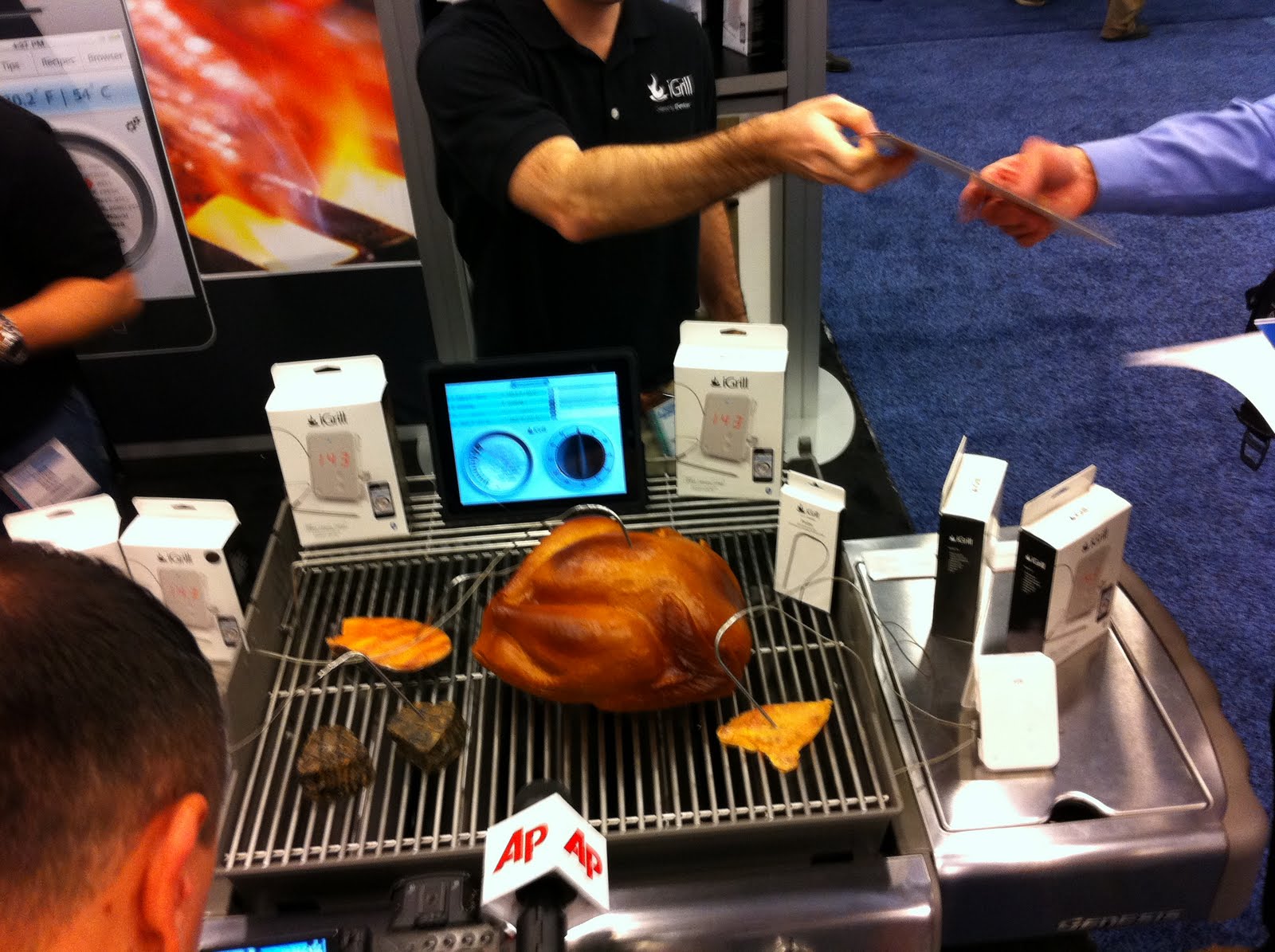
I am an Apple whore, and even I would not really consider using my iPhone as part of my BBQ apparatus.

But I bet this guy would use it, not probably not to roast a pig....

These "customizable" iPhone covers were cool....not available yet, but when they are, I will get one and let my kids decorate it.

One thing I was not tempted to try was any of the headsets/earphones that were available.  A couple of vendors actually had boxes of the little rubber ear nubs so that yours were unused, but most just laid out a pair for person after person to try on......yuck.

And here was something you need for your iPhone....you know, to use it as a phone, if the whole magic of wireless makes you confused.

The people watching at Macworld was awesome.  If you don't think you will survive a Star Trek convention, this is a good warmup.

Thursday, January 13, 2011

Verizon iPhone?

Like many longtime iPhone users, I have grown quite unhappy with AT&T's service.  My iPhone is practically useless for data in SF, and I often end up firing up my Verizon MiFi.  For calls it is much better. A lot of people complain about dropped calls, but my experience is pretty good.  And, of course, the customer service rivals United Airlines.  Check out these happy missives from an AT&T rep.

Unfortunately, my iPhone fell out of my jersey pocket about a month ago while I was cycling at about 20mph.  This scenario is apparently outside of the design spec, but it handled it well.  It fell face down (ouch), so it popped out of the case.  The ziploc I carry it in provided little protection (too bad it did not fall in a puddle), but the glass was only dinged up by the corners.  Unfortunately, it appears that I concussed my little phone, and it has not recovered.  It runs at about 1/3 to 1/2 of normal speed, which has become maddening.  Click the home button, and it may or may not do something, but you have to wait a few seconds, before clicking again, or it might think you were double-clicking.  Folders open very slowly, and apps launch with a delay.  Typing sometimes freezes for 5 seconds.

It basically has had a stroke, and now has the mental faculties of my first generation iPod Touch.  To replace it with a new one will cost $700, or $500 if I use my upgrade eligibility with AT&T.  At those price levels, I can pay the outrageous early termination fee of $325 and get a new one on Verizon, and come out close to the same.

So how do the carriers stack up in my estimation?

Verizon iPhone

Positives

  • Reliable network with decent data speeds
  • Hotspot ability
  • Not AT&T
Negatives

  • No calling and data usage at the same time
  • No roaming internationally
  • Network might get slammed over the next year

AT&T iPhone

Positives

  • GSM--works abroad, and can call and use data at the same time.
  • Rollover minutes--I paid for them, don't take my minutes away.
  • The Devil I know.
Negatives

  • Serious network issues in SF
  • No Hotspot capability (a policy matter more than a hardware constraint)
  • No current unlimited data plan (but I am grandfathered in on my unlimited plan)


But, I think I am going to stay with AT&T.  I am presuming that over the next 6 months, as subscribers head for the exit to Verizon, that the network will improve.  Both because there will be a bit less traffic, and because AT&T will be forced to spend some money before it stock price completely craters.  Of course, there are probably all sorts of government impediments to getting more towers up in SF.  But, hey AT&T, this is the town of Willie Brown.  Money solves things here.  Also, my wife and I are on a family plan, so I would have to get her a new iPhone as well.

The ability to use GSM abroad is nice, but I don't really travel abroad any more.  And when I did, I had a separate phone to avoid getting gouged for roaming (and calls at 3am GMT from your buddies).  I do use the voice and data simultaneously reasonably often.  I may be on the phone in the car and want to check traffic on Google Maps to figure out a way around congestion.  Or I may be checking in to a location whilst on a call.  It is alleged that Verizon is working to fix this in 2011.

Rollover minutes are philosophically appealing because I paid for those minutes, and I like the idea that I have some flexibility about when I use them.  Of course, having multiple data devices because I can't use the iPhone as a hotspot overcomes the financial savings of rollover by a long way.  The pinch with Verizon's iPhone hotspot is that you cannot be on the phone at the same time.  So you are working away in a coffee shop with a couple of colleagues, and the phone rings, so you have to end the data session.  Or you want to be on a conference call at the same time.  Free wifi is getting scarce, so this is a real problem.  But, I did read today a rumor that AT&T will offer the same thing in March.  However, AT&T's tethering plan does not make much sense.  It includes tethered use in your measly 2GB monthly bucket of data.  Verizon gives you a separate 5  GB allocation for tethered data (though they charge more for it).

The good news for me is that I suspect there will be a bunch of pissed off AT&T iPhone users who will move in February to Verizon.  This will create a flood of used GSM iPhone 4s, and I can pick one up to replace my crippled unit without extending my contract period.

I think that next year, when we might see an LTE-capable iPhone on Verizon, will be a more compelling case to switch.  LTE is a GSM-based standard, so it will definitely support simultaneous data and voice.  And, it will be faster.  Mind you, raw download speed is rarely a limitation for me.  Pulling emails and simple browsing is more about network latency and the strength of the data signal.

Saturday, January 8, 2011

Rants on bureaucrats


A recent ride on the Queen K Highway on the Big Island got me thinking about some of the stupid decisions made by bureaucrats and coin-operated politicians.  Granted, many private company executives make stupid decisions, but they often get fired for them.  And, as a taxpayer, I feel like I can gripe about how my dollars are spent.

Here is Exhibit A.  Road Shoulder Indicators

These gouges in a perfectly good road surface are there to let motorists know that they are deviating from the road.  The reflector on the left performs the same role.  Both are annoying to cyclists, and in the case of the gouges, actually are so bumpy that they bounced my water bottle out of its cage.

Now, if you are so drunk, stoned or stupid that you don't notice the thumping from the reflectors, you probably won't notice the gouges either.  And, in any case, as a society don't we want you to run off the road and perhaps remove yourself from the gene pool, instead of recovering so that you can wander into oncoming traffic and take someone else with you?

Headset requirement

In many states, including California, there are now laws in place that require you to use a headset when you are driving whilst on the phone.  This seems like a good idea at first examination.  If you are a politician, it certainly seems like a good idea when the lobbyist for the headset manufacturers (which pushed the bill in CA) takes you to nice lunches.

The problem is that with real science, this turns out to be exactly a bad idea.  You see, the problem is not that holding a phone causes distracted driving and leads to accidents.  The problem is that talking on the phone causes distracted driving.  A University of Utah study showed no difference in the cognitive distraction between talking on the handset or handsfree.  A Nordic study show the same result.  But here is the rub.  Using a headset is more comfortable, and therefore you spend more time talking on the phone.  So........using a headset is more dangerous.  Apparently the lobbyist failed to mention that.

High Fructose Corn Syrup

Our esteemed politicians continue to use my tax dollars to provide generous subsidies to corn farmers.  This makes corn super cheap, and an end result is that High Fructose Corn Syrup is cheaper to use than sugar.  Well, our bodies evolved to process sugar efficiently and with minimal disruption, but HFCS is like sugar on meth.  Many pediatricians believe it is a leading cause of child obesity.  Your body just does not deal with it well, and it creates a blood sugar spike, followed by an insulin reaction, followed by feeling hungry.

The irrationality here is made complete by Mexican Coke.  You see, Mexico does not have ridiculous corn subsidies.  With the artificial subsidy, good old sugar is still the sweetener of choice.  So Coke in Mexico is made with sugar, not HFCS.  Even better--I pay extra to get Mexican Coke, that has to travel all this way, in order to avoid HFCS.  You are now starting to see it in a lot of upscale markets and at Costco.

We talk about reforming health care costs, while our government promotes a childhood obesity epidemic with subsidies for poison.  Nice.

Things I still use (almost) every day

At the suggestion of a friend, I am updating my post from a year ago about the gadgets I use frequently.  I was thinking not much has changed, but there have been subtle adjustments.  This is because I think the past year has been mostly evolutionary in terms of technology.  The only big change is the iPad--of course I have one.  I got it on launch day and have used it almost every day since.

Let's review last year's list:
  1. Canon S90
  2. Vibram Five Finger Shoes
  3. Evernote
  4. Google
  5. iPhone
  6. Motorola BT715HS bluetooth headset
  7. Dropbox
  8. RSS & Twitter
  9. 1Password
  10. Xmarks
Of course, as I go over the list, I realize a few things have changed.

Let's add the iPad to the list.  While I am actually underwhelmed by the iPad as a laptop replacement, I still use mine every day to read the newspaper, scan RSS feeds and show videos to the kids.  I can now read the Economist, Wall Street Journal, New York Times and HBR on it.  With Hulu I can watch TV on it (though I don't bother).  You can read more about my thoughts on the iPad here and here.

The awesome portability but crippled power of the iPad led me to get a MacBook Air 13" in November.  The Air is an amazing machine.  It has almost all the power of the MB Pro 15" I purchased only 15 months ago, in half the size.  The difference in the weight of my bag is more dramatic than I expected.  Between the laptop itself and the smaller power brick, I have probably dropped about 3 pounds, but it feels like more than that.  See my review here.

The Canon S90 was in regular use until it met with death by Diet Coke three weeks ago, at the start of our family vacation.  It had seen some hard use and was not the camera it once was--picture quality was definitely waning.  I was going to replace it with the newer S95, but ended up getting a $100 Canon something or other at Target instead.  This was due to a combination of factors.  In the summer I purchased a Canon T2i DSLR, which takes amazing photos and is my go-to camera when I know I will be taking pictures, and can be bothered to carry it.  So I used the S90 less, and it was really my wife who was using it.  She just throws gadgets in her purse, which, judging by the abuse dished out to said gadgets in a short time frame, must be filled with sharp rocks.  The lens was covered in fingerprints, and the casing and LCD were scratched.  So, when I thought about what fate awaited the new camera, I decided something more disposable was in order.

Another factor is that we are both carrying the iPhone 4, which has a pretty decent camera on it.  It does not work well for poorly lit shots, but for everything else it is quite decent.  Add the ability to upload to Facebook or wherever immediately, and it becomes a compelling snapshot machine.  I am still thinking about getting an S95.  They can be had for $370 now, and carrying the DSLR is a pain.  Olympus just threw the XZ-15 into the same ring, with an even better lens, but it will be $500 and looks to be a bit bigger.  I have also considered getting a Micro 4/3 camera, but halfway in size between a point and shoot and a DSLR is kind of no man's land--you can't put it in your pocket, so why not carry the big iron?

Speaking of the iPhone, it obviously stays on the list.  The iPhone 4 was a nice, but not necessary upgrade from my 3Gs.  It is not really any faster, but I like the display and the better camera.  I also use the LED flash as a flashlight (using LED Light for iPhone).  Having a connected camera is really a game changer, and we are just starting to see the camera manufacturers figure that out with some of the products being launched this week at CES.  Sadly, my iPhone 4 tumbled out of my jersey pocket on a ride a month ago.  It survived with a few scratches, but it seems to be running at half speed, which is infuriating.  I have considered downgrading back to my 3Gs.  I have also considered waiting for the Verizon iPhone and swapping carriers if I have to get a new phone anyway.  For now I am in wounded iPhone limbo.

I have even considered getting an Android phone, but it still feels like the OS is not as slick as iOS, and the app ecosystem around it is certainly less developed.  Ultimately, I think that Android will be 3/4 of the smartphone market, but it will be the bottom 3/4.

I still have my Vibram Five Finger shoes, and they are still my preferred footwear for going to the gym.  I do a lot of my exercises from unstable positions (to activate my core), and these shoes really help you feel planted to the ground.  I don't wear them every day, though.  Mine have no insulation, so they are not great outside in winter (there are models with insulation).

I still use Evernote for taking notes and storing key articles.  Other options have come on the market, but Evernote for me is still the king.

I have further entwined myself into Google's web in the past year.  I still use them for mail and contacts.

All is not rosy, however, in my marriage to Google.  I was a bit disappointed that the Exchange integration for the iPhone requires that you enter your security code if you have not used the iPhone for 5 mins.  There should be more flexibility in those settings.  I also can't accept a meeting invitation from my wife, who is still using iCal, on my iPhone.  I can only seem to do it from the desktop browser.

Google also messed up my two tier identity.  I have a gmail that I use for lower priority emails and things like this blog, Picasa and YouTube.  When Google went to their single sign-on system, it made things harder, not easier.  Now when I log into a Google service with my Gmail handle, it logs me out of my primary Google Apps email.  So, I end up using a separate browser for my Gmail stuff.  That seems retarded, and hopefully they are working that out.  I know that they are focused on the problem, because a lot of people have a similar setup with a Google Apps account and a consumer Gmail account.

I generally use the browser client for Gmail, but when I feel like going desktop, I use Postbox.  It is miles better than Apple Mail for Gmail or Google Apps mail.

Chrome is now my default browser.  Firefox works a bit better for extensions and a couple of websites I use (eg. Strava), but it is slow, and seems to churn the processor incessantly.  And, it crashes.  With Chrome, each tab is a separate instance, and so only a single tab will crash, without taking down the whole browser.  A key enabler for me was 1Password (for filling passwords and forms) getting their Chrome extension sorted out, which really only happened towards the end of 2010.

Speaking of 1Password, I still use it, obviously, but I have been thinking about moving to LastPass, for two reasons.  First, I received one of the Google CR-48 netbooks with the ChromeOS, which I also use just about every day.  1Password does not work with ChromeOS yet, but that will presumably change soon.  LastPass also bought Xmarks, which is use for syncing bookmarks across browsers and machines.  Xmarks has been a bit balky lately, but I think that is because I was syncing Chrome with its built in synchronization option as well as Xmarks, and they were conflicting.  Roboform has also moved on to the Mac side.  Roboform was my choice for filling passwords and forms until I went to the Mac, and it was Windows-only until recently.  So now there are 3 good choices.  I need to play around a bit to decide which I like best.  That is not high on the to do list.

The ChromeOS is interesting, and almost to the point that I could use it as my travel machine.  The hardware is crap, especially the trackpad, but that will be fixed by the public release.  My bigger issue is that I am not ready to go 100% web-based yet.  I still use MS Office for a few things where I need more power than Google Docs can provide.  So the daily use prize goes to the MB Air, and the ChromeOS netbook gets used often, but out of curiosity as much as anything.

The Motorola headset has been replaced by a Jawbone Icon.  People complained constantly about the sound quality of the Motorola.  People still complain about the Jawbone, but not as much.  Basically bluetooth headsets seem to be a half-baked technology.  I use old-school Jabra ear gels on my headset to get it snug in my ear.

Dropbox is also still a huge benefit for me.  I work across multiple machines, and Dropbox makes it easy, as well as providing an additional backup for key files.  Speaking of backup, I should also add my Drobo to the everyday list.  My old external backup drive crapped out, leaving me feeling very vulnerable.  The Drobo is basically a faux RAID array.  It is not cheap, but it is very flexible and I can upgrade capacity as I need it quite cheaply.  I use a multi-layer backup strategy, which I will detail in a separate post because it is boring, and the Drobo is a key element.  Apple betrayed me in November when an iPhoto upgrade corrupted my wife's iPhoto file, causing much consternation.  I, of course, took the brunt of the blame for attempting so foolish a thing as an upgrade.  I learned a few things from that.

And that gets us, finally, to RSS and Twitter.  Despite some recent articles that RSS is dead, I still use it as my primary source for consuming news.  I use Google Reader on the desktop, and MobileRSS on my iPhone and iPad (which syncs fully with Google Reader).  Twitter has become more useful with Flipboard on my iPad, which dramatically improves the readability Twitter by previewing the content--most tweets now are just a headline with a link.

So I guess I should add Flipboard to the list--it is awesome.  And, it can now integrate your Google Reader feeds.  I still prefer an RSS Reader for this, though, because I find it more efficient, but that may change with time.

And we can add my Garmin cycling computer.  I use it every day that I ride, and that is most days.  I am a data geek, and I like to know everything.  The Garmin tells me where I have been, how long it took, my heart rate, power output, temp, speeds, etc.  What has made it cooler is being able to upload it to Strava and compare my performance against myself and others.

So, where does that leave us?  We lost a camera, but we gained an iPad.  The rest is mostly the same or swaps for incremental improvement.

  1. Canon S90--killed.  Missed but not replaced.
  2. Vibram Five Finger Shoes--still here.
  3. Evernote--still here.
  4. Google--still here, and more entangled than ever.
  5. iPhone--new version.
  6. Motorola BT715HS bluetooth headset--ditched for Jawbone Icon
  7. Dropbox--still loving it.
  8. RSS & Twitter--yep.
  9. 1Password--yes, but under review.
  10. Xmarks--yes.
  11. iPad
  12. Flipboard
  13. Drobo
  14. Garmin Edge
  15. MB Air 13"

Back 'em up!

Apple betrayed me a couple of months ago, and in doing so laid bare some erroneous assumptions about my data backup strategy.

When I got my MB Air, which came with iLife '11, I bought the new iLife for my other machines as well.  When I upgraded my wife's machine, it blew up and corrupted the iPhoto file.  This, as it turns out, happened to a lot of people.  This was inconvenient, to be sure, as her iPhoto file was 80 gb, and so recovering it would take a while.

Well, it was worse than that.  I had what I thought was a foolproof backup strategy.  That turned out not to be the case.

My backup strategy is layered:

  • Google for mail and contacts.
  • Dropbox--primary working files go here.
  • Time Machine (on a 1TB Time Capsule) for incremental backups of everything.
  • JungleDisk backing static files like music and photos to an Amazon S3 account.
  • Super Duper! making a clone of my hard drive every month or so to an external drive.
So far, so good.  The problem lay in the fact that Kate only has the Time Machine component.  She has external hard drives, but neglects to back anything up to them.

Time Machine has some problems.  If you never properly quit out of iPhoto, it can't back up the library.  Kate usually closes the window and assumes that the program has quit.  This is how it works in Windows, but not on the Mac OS.  You have to actually quit the program.  So, iPhoto stays open, along with Mail and other frequently used programs, all the time.  She did not have a recent Time Machine backup of her iPhoto library.

Also, recovering files from Time Machine turns out to be hit or miss.  In this case, it was mostly miss.  I could see the file I wanted, and start the recovery.  But it would always fail before finishing.  Perhaps this was because the file size was so large.  And, to make matters worse, it would work on recovering for about 24 hours before failing.

So, 3 days later, I am in ever increasing trouble with the wife, and not sure how to get her photos back.  Apple, had, in the meantime, 'fessed up to the fact that iPhoto '11 was a cluster, and issued an update.

Using third party software to browse the Time Machine backups, I was finally able to get her iPhoto file from about 2 weeks prior.  The whole process took almost a week--ugh!

A second thing happened that had me thinking about data backup.  My 1TB LaCie external hard drive failed.  I did not lose any data, but I felt a bit naked for a week.  I took the thing apart to see if I could recover the data from the hard drive inside.  It turns out that there are 2 500 gb drives, and some sort of control mechanism that meant I could not get the data off of the drives.

I replaced it with a more industrial grade solution--the Drobo.  The Drobo is basically a consumer-level RAID (Redundant Array of Inexpensive Disks) device.  It has 4 slots for drives.  With multiple drives, it replicates data across the drives so that when one fails, you don't lose any data.  You just replace the drive and keep on truckin'.  I got the lowest level, which is still $400 without drives--ouch!

So now I feel pretty solid on my backups.  My email and contacts are in the cloud with Google, and replicated locally on my machines.  The files I work on consistently are on Dropbox and replicated into the cloud as well as across my machines in real time.  JungleDisk backs those up again to the cloud plus adds my media, every 24 hours.  Time Machine is backing everything up, and may or may not let me recover it, every hour.  About once a month I copy media files to the Drobo, and make a bootable clone of my hard drive.

If I lose my laptop (likely), then I just change my Google passwords (even though I run 2 factor authentication), get a new one and I am back to normal within an hour.  In fact, I just assume that at some point someone will steal my laptop and I make arrangements accordingly.  That was the impetus for setting up my original layered backup system, when my laptop was my only machine.  Now, I really have data in too many places--I need to go through and prune stuff off of older machines that I don't use.

If someone cleans out my whole office, including the iMac, Drobo and Time Capsule, I can still recover my important data files easily, but it would take me a bit more time to set up my computers with all the software I use.

Overkill?  How valuable are the photos of your kids?  Can you recover them if someone steals your computer?  Your emails?

Speaking of which, how secure are your passwords?  If someone has access to your computer, do they have access to your usernames and passwords?  If you save them in your browser then they do.  Use a secure password manager like 1Password, LastPass or Roboform.

Friday, December 10, 2010

MB Air vs. iPad

I got an iPad on launch day, hoping to free my back from the tyranny of carrying my MB Pro.  My intention was for the iPad to be my conference machine.  At conferences, I typically only need a browser, Twitter and Evernote.  Simple enough.  The iPad can handle all these just fine.

But my first few gos were not that pleasing.  The virtual keyboard on the iPad is actually decent.  At first I carried an Apple bluetooth keyboard, but I found that it did not add enough value for the weight and bulk.

The size and battery life of the iPad are great.  I can wander around a conference without a bag, just the iPad in my hand.  No need to carry a plug.  Chances are, at most conferences, there won't be any available.  Big props to TechCrunch in this regard, for stringing hundreds of power strips and even good old ethernet--I love you guys for that.

There were two real problems that were holding me back from loving the iPad as a work machine (I love it at home for reading and the kids).

The first was the lack of multitasking.  Switching between apps was cumbersome, and it caused me to miss some notes I should have taken, or not get a witty tweet out (horror!).  Of course, this problem has finally been somewhat solved with iOS 4.2, and the iPad is now much better, though still not as slick as just clicking between windows.

The second was, and is, the crippled browser.  Mobile Safari is just not a great browser, and the lack of support for extensions means that I can't use 1Password or LastPass in the native browser.  Since I can't remember most of my passwords, that means I can't browse a lot of sites.  Also, many sites just don't seem to work that well in Mobile Safari, either because of Flash or other issues.  I have gotten used to extensions that shorten URLs, mail out links, etc., that make my life easier.  None of this works on the iPad.

A related issue is really Google's fault.  The consolidated account system they now use in Google Apps, so that my Google Apps account and my Gmail are linked, is really a pain in the ass.  It makes it harder to work across the accounts in a single browser, instead of easier.  So, on my laptop I just use Safari for Gmail and Chrome for Google Apps.  On the iPad, you are in one or the other, and fast switching, which is possible on the desktop browser, is not supported in the mobile version of Google Apps.  The Mail app is better in 4.2, but still does not quite integrate properly with Gmail.

So, I resolved to get an MB Air.  At first I was just going to pick up a used one during the summer.  But then I heard rumours about a new model on its way.  For some reason, people on Craigslist seem to be on crack when it comes to what they think their used gear is worth.  And so I waited, and waited, and waited.  And, finally, last month I got one.  The MB Air has basically the same specs as my MB Pro, but at half the size.  It is about twice the size of the iPad, but so much more useful.  The iPad's battery life was a huge plus for conferences, but the Air can go all day as well, especially if I can get wifi and don't have to use my MiFi.

The iPad has been relegated to home duty.  The kids love to read stories and watch videos on it.  I read the morning paper and catch up on RSS feeds.

Interestingly (well, maybe only to me), Twitter has been a casualty of the iPad demotion.  I love to read Twitter on Flipboard, so I wait until I grab my iPad to read it, instead of following throughout the day.

I almost got the 11" Air, which is more appropriately an iPad replacement.  But the screen on the 13" is more usable, and it gives me a lot more power for when I work remotely.  Still, that 11" is so small.  For users who do most of their stuff in the cloud but still need more than a netbook, it may be the perfect laptop.